People power needed to eliminate the 'canetoads of the sky'
Published on 05 March 2026
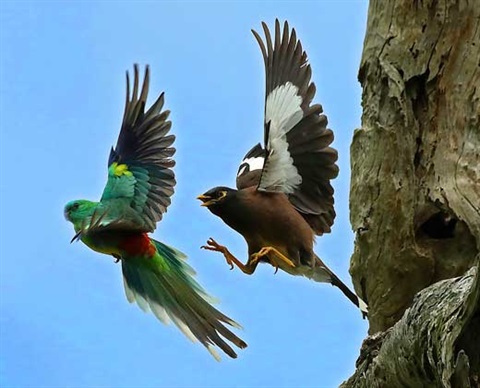
Mackay residents are being asked to join a community-driven project to try and eradicate a highly invasive species.
The Mackay Indian Myna Bird Action Group (MIMBAG) recently received several traps that were built by members of the Mackay Men's Shed Inc. These will be loaned to residents, free of charge, to try and catch as many of the pests as possible.
Member of MIMBAG committee member and Birdlife Mackay, John Morris said there’s been an increased awareness of the scale of the problem in recent months and now is the time to take action.
“These pests pose significant threats to native bird species – harassing and evicting them from their nests, killing native young and destroying eggs,” Mr Morris said.
“They also pose a significant biosecurity and economic threat to our local agricultural sector and human health.
“What we need now is for members of the community to come along to learn more about how to trap the birds and get involved in our community trapping program.
“MIMBAG is currently working through the process to become an incorporated group, which may allow us to access funding for things like additional traps and to cover the costs of humane euthanisation.”
Mackay Mayor Greg Williamson said Indian Myna birds have established large populations along Australia’s eastern seaboard.
“Like the canetoad, the species was brought into Australia to try and control insects. They first arrived in the 1860s to control pests in market gardens in Melbourne,” Mayor Williamson said.
“They were then introduced to northern Queensland to try and control pests in sugar plantations," he said.
The species is a prolific breeder, with each mating pair laying up to 15 eggs per year.
Modelling shared by the Dubbo Indian Myna Control Program details the exponential population growth from just one breeding pair.
“From those two birds, their young and future generations can produce more than 90,000 birds within six years,” Mayor Williamson said.